Kyoto to Osaka on a Budget + Cheap Eats Guide: Japan's Street Food Capital (2026)
Get from Kyoto to Osaka for under ¥600, then eat like a king for ¥300 a bite. The honest budget traveler's guide to Osaka street food and Dotonbori.
This post contains affiliate links. If you book through my links I earn a small commission at no extra cost to you — it helps keep BudgetYen running.
After the temples, bamboo groves, and early mornings of Kyoto — covered in our free Kyoto guide — most travelers are ready for something louder. Osaka is that something. It’s the street food capital of Japan, the cheapest major city in the Kansai region, and just 15–30 minutes from Kyoto depending on which train you take.
Osaka is generally cheaper than Kyoto, especially for food and nightlife. Street food in Dotonbori averages ¥300–¥800 per item, and budget meals start at ¥500. Accommodation is roughly similar, though Osaka has more hostels and budget business hotels.
This guide covers how to get there for under ¥600, where to eat for almost nothing, and how to do Osaka properly on a budget.
Getting from Kyoto to Osaka — The Cheapest Options
This is the most underrated route in Japan for budget travelers. Every travel guide sends you on the JR Line — but it’s not the cheapest option. Not even close.
Option 1: Hankyu Railway — the budget traveler’s choice (¥410)
The Hankyu Kyoto Line runs between Kyoto (Kawaramachi Station) and Osaka (Umeda Station) with trains every 10–15 minutes. A return on Hankyu is only ¥820, and you skip higher Kyoto accommodation costs — it’s ¥410 one way.
The journey takes 43 minutes on the limited express, or about 55 minutes on local trains. Not covered by the JR Pass — but at ¥410, you’re saving ¥900+ compared to the JR option. For a budget traveler, that’s lunch.
How to board: Load your IC card (Suica or ICOCA) and tap in at Kyoto-Kawaramachi Station. Take the Hankyu Kyoto Line Limited Express towards Osaka-Umeda. Tap out at Umeda.
Option 2: JR Kyoto Line — faster, more expensive (¥570)
The JR Rapid or Special Rapid service runs from Kyoto Station directly to Osaka Station (not Umeda) in 28 minutes. ¥570 one way. Covered by the JR Pass if you have one. If you don’t have a JR Pass, the Hankyu saves you ¥160 and adds 15 minutes — your call.
Option 3: Meitetsu Bus / Highway Bus — slowest but cheapest on the right day (¥800–1,500)
Highway buses run between Kyoto and Osaka for ¥800–1,500 depending on the operator and time of day. Slower (45–75 minutes depending on traffic), but sometimes the cheapest option if you book a few days in advance through Willer Express.
Honestly for this short route, just take the Hankyu. The saving over highway bus doesn’t justify the added time.
The route summary
| Option | Cost | Time | Covered by JR Pass? |
|---|---|---|---|
| Hankyu Railway | ¥410 | 43–55 min | No |
| JR Rapid | ¥570 | 28 min | Yes |
| Highway Bus | ¥800–1,500 | 45–75 min | No |
Budget verdict: Hankyu every time unless you already have a JR Pass.
Why Osaka Is the Best City in Japan for Budget Eating
Osaka has a cultural concept called kuidaore — roughly translated as “eat until you drop.” Locals take this seriously. The city has the highest density of restaurants per capita in Japan, competition keeps prices low, and the food culture is entirely built around feeding people well for not much money.
Where Kyoto skews towards expensive kaiseki and Kyoto cuisine, Osaka is gyoza, takoyaki, okonomiyaki, and ramen — all of it fast, cheap, and genuinely excellent. This is the city where Japanese fast food actually started. A budget traveler in Osaka eats better than a mid-range traveler in most other cities.
The Osaka Street Food Budget Guide
Dotonbori — the famous strip (and how to eat here cheaply)
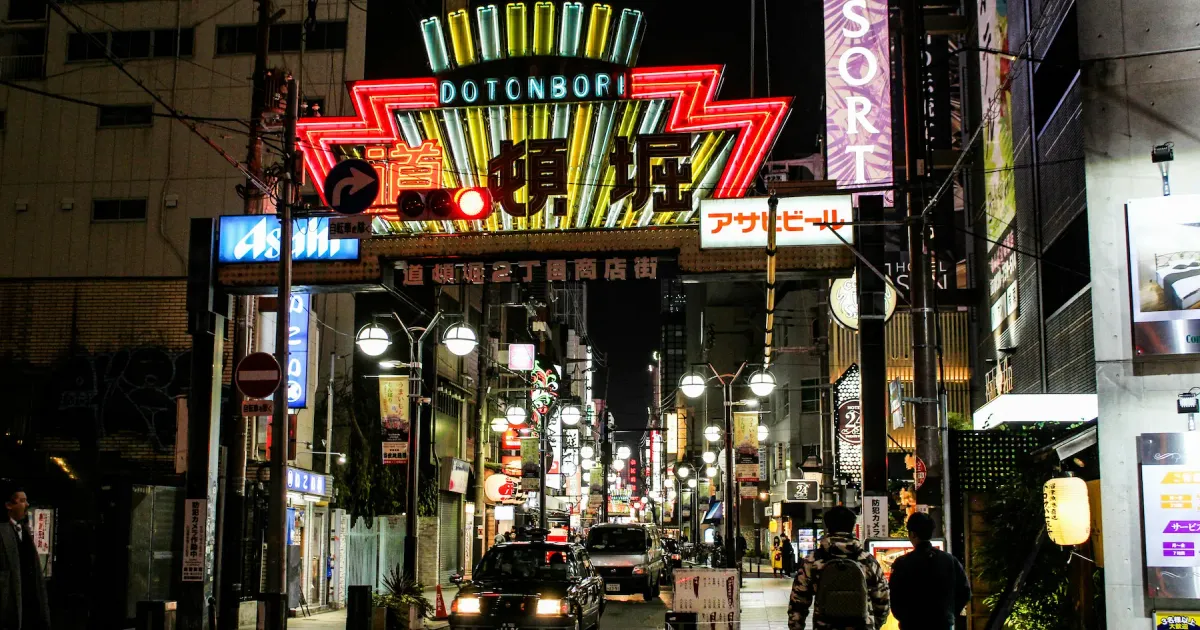
Dotonbori is Osaka’s most famous food street, running along the canal in Namba. It’s legitimate — the food is genuinely good and the atmosphere at night, with the neon reflections on the water, is one of the best urban experiences in Japan.
The trap is the sit-down restaurants with picture menus aimed at tourists. Walk past those. The cheap eating in Dotonbori is at the street stalls and standing counters, not the restaurants with outdoor hosts.
What to eat and what to pay:
Takoyaki (たこ焼き) — ¥500–700 for 8 pieces Osaka’s most famous food. Octopus balls, crispy outside, molten inside, topped with bonito flakes, mayo, and takoyaki sauce. Eat them fresh from the stall — they cool fast. Kukuru and Aizuya are the most famous in Dotonbori, but any stand with a queue is worth trying.
Okonomiyaki (お好み焼き) — ¥700–1,200 Japanese savory pancake loaded with cabbage, pork, seafood, and your choice of toppings. Osaka-style (called “Kansai-style”) is mixed and cooked all together, unlike Hiroshima-style which is layered. Cheaper at lunch than dinner. Look for counter seats where you cook your own — usually ¥200 cheaper than table service.
Kushikatsu (串カツ) — ¥100–200 per skewer Breaded and deep-fried skewers of meat, vegetables, and seafood. Shinsekai district (south of Namba) is the home of kushikatsu culture. Order 8–10 skewers and a beer and you have a full meal for ¥1,500–2,000. The golden rule: never double-dip in the shared sauce. It’s a local law and they’re serious about it.
Ramen — ¥700–900 a bowl Osaka ramen tends towards lighter shoyu and shio broths compared to Tokyo’s heavier styles. Standing ramen counters (tachinomi) cut the price by ¥100–200 compared to seated restaurants. Look for the plastic food displays outside — if the ramen looks good in plastic, it’s usually good in the bowl.
Kuromon Ichiba Market — Osaka’s Kitchen (free to walk, cheap to eat)
A 580-meter covered market in Namba, Kuromon Ichiba has been running since 1822. It’s Osaka’s equivalent of Kyoto’s Nishiki Market but larger, louder, and cheaper.
Most stalls open from 9am and start closing around 5pm — get there before lunch for the best selection. Vendors sell fresh seafood, Japanese pickles, wagyu beef, and prepared foods you can eat as you walk.
Budget eating strategy at Kuromon:
- Grilled scallops: ¥200–400 each
- Fresh oysters: ¥200–300 each
- Wagyu beef skewer: ¥500–800
- Tamagoyaki (egg roll): ¥200–300
- Crab claw: ¥300–500
A full Kuromon breakfast/brunch of grazing stalls costs ¥1,000–1,500 and is a genuinely great meal. No sit-down required.
Getting there: 3-minute walk from Namba Station. Free to enter.
Shinsekai — The Most Underrated Budget Neighborhood in Osaka
Built in 1912 to evoke Paris and New York, Shinsekai fell into decline and then became beloved for its retro charm and extremely cheap food. It’s the kushikatsu capital of the world and one of the most atmospheric neighborhoods in Japan for budget eating.
Everything here is cheaper than Dotonbori by 20–40%. The locals are older, the vibe is more authentic, and the kushikatsu is arguably better. Walk down Janjanyokocho — a covered alley lined with kushikatsu restaurants, shogi clubs, and vintage bars — for the most un-touristy experience in Osaka.
What to budget: ¥1,200–1,800 for a full kushikatsu meal with a drink.
Convenience Store Meals — The Budget Traveler’s Secret Weapon
Japan’s convenience stores (7-Eleven, Lawson, FamilyMart) are not a last resort — they’re a legitimate part of eating culture here. The food quality is genuinely high, preparation happens fresh throughout the day, and prices are exceptional.
The best value buys:
- Onigiri (rice balls): ¥130–180 each — a full snack or light breakfast
- Hot sandwiches from the heated cabinet: ¥200–280
- Ramen or udon from the hot food section: ¥300–450
- Bento boxes (discounted 20–30% after 8pm): ¥350–450
A full konbini day — breakfast, lunch, snacks, dinner — costs ¥1,200–1,800. Nothing else in Japan matches that value. Don’t feel like you’re cutting corners. Every Japanese person eats konbini regularly.
The Budget Osaka Neighborhood Guide
Where to stay for the cheapest prices
Shinsekai / Namba area: Most budget hostels and capsule hotels cluster here. Walking distance to Dotonbori, Kuromon Market, and easy train access everywhere. Hostel dorms run ¥2,800–4,000/night — noticeably cheaper than equivalent Kyoto accommodation.
Osaka’s secret budget hack: Stay in Osaka and day-trip to Kyoto. A return on Hankyu is only ¥820, and you skip higher Kyoto accommodation costs — saving ¥2,000–4,000 per day. If you haven’t done Kyoto yet and you’re planning your base: this is the move. Stay in Osaka, wake up early, take the Hankyu to Kyoto for sunrise at Fushimi Inari, return to Osaka by afternoon.
👉 Search budget accommodation in Osaka on Booking.com — filter by guest rating 8.0+ and you’ll find solid hostels and capsule hotels in the ¥2,800–4,500 range.
What’s Free in Osaka
Osaka has fewer free temples than Kyoto — it’s primarily a merchant and food city rather than a temple city. But the free experiences are excellent:
Dotonbori canal walk — the most photogenic walk in Osaka, completely free. Best at night when the neon signs reflect on the water.
Shinsaibashi shopping arcade — the longest covered shopping arcade in Japan. Free to walk, fun to browse, great people-watching.
Osaka Castle Park — the park and grounds are free. The castle itself charges ¥600 to enter (worth it for the museum inside, skip if budget is tight).
Namba Parks rooftop garden — a rooftop terraced garden above a shopping mall. Free to access, great views, almost nobody knows about it.
Sumiyoshi Taisha Shrine — one of Japan’s oldest shrines, founded in the 3rd century. Free to enter, rarely crowded, a genuine counterpoint to touristy Osaka.
Linking Your Kansai Trip Together
By this point in your trip, you’ve covered the core Kansai circuit on a budget:
Step 1: Arrived in Kyoto from Tokyo on the overnight bus for ¥3,500 → Full Tokyo to Kyoto budget transport guide
Step 2: Spent 2–3 days in Kyoto hitting free temples and neighborhoods → Free things to do in Kyoto guide
Step 3: Took the Hankyu from Kyoto to Osaka for ¥410, eating your way through the street food capital of Japan — you’re here now.
From Osaka, the natural next stops are:
- Nara — day trip, ¥800 return, free deer park, Todai-ji temple (¥800 entry)
- Hiroshima — Shinkansen from Osaka at ¥10,500 (or look at the Sanyo-San’in pass)
- Fukuoka — Japan’s most underrated city, cheapest in western Japan
The Osaka Budget Day Template
7:00am  Konbini breakfast near your hostel (~¥400)
8:30am  Kuromon Ichiba Market — graze through stalls (~¥800)
10:30am Shinsekai walk — Tsutenkaku Tower area (free)
12:30pm Kushikatsu lunch at Shinsekai counter (~¥1,500)
2:30pm  Dotonbori walk, Shinsaibashi arcade browse (free)
4:00pm  Osaka Castle Park (free grounds, optional ¥600 museum)
6:30pm  Return to Dotonbori for takoyaki + sunset canal (¥600)
8:00pm  Namba for evening atmosphere, street food grazing (~¥600)
Total food: ~¥3,900
Total transport (within Osaka): ~¥600
Activities: ¥0–¥600
Full day total: ¥4,500–5,100 ($30–34)
Frequently Asked Questions
What is the cheapest way from Kyoto to Osaka?
The Hankyu Railway at ¥410 one way is the cheapest realistic option. It runs every 10–15 minutes from Kyoto-Kawaramachi Station to Osaka-Umeda, takes 43 minutes on the limited express, and is not covered by the JR Pass — meaning it saves money for any traveler without a pass.
How much does street food cost in Osaka?
Takoyaki (octopus balls) costs ¥500–700 for 8 pieces. Kushikatsu skewers run ¥100–200 each. Okonomiyaki is ¥700–1,200. A full meal of street food in Dotonbori or Shinsekai typically costs ¥1,000–2,000 per person.
Is Osaka cheaper than Kyoto?
Yes. Osaka is generally 10–20% cheaper than Kyoto for accommodation and food. Budget hostels in Osaka’s Namba area run ¥2,800–4,000/night versus ¥3,500–4,500 in Kyoto. Food is significantly cheaper — Osaka’s street food culture means excellent meals for ¥500–800 that would cost ¥1,000+ in Kyoto.
Can I day-trip to Kyoto from Osaka?
Yes, easily. The Hankyu train takes 43 minutes and costs ¥410 each way. This is a popular budget strategy — base yourself in Osaka (cheaper) and day-trip to Kyoto for temples and sightseeing.
What is Dotonbori in Osaka?
Dotonbori is Osaka’s most famous entertainment and food district, running along a canal in the Namba area. It’s lined with restaurants, street food stalls, neon signs, and the iconic Glico Running Man billboard. It’s free to walk through and most famous for takoyaki and street food.
Is Osaka worth visiting for budget travelers?
Yes — it’s arguably the best city in Japan for budget travelers specifically. The street food culture means excellent eating at low prices, accommodation is cheaper than Tokyo and Kyoto, and the entertainment (markets, arcades, canal walks) is largely free.
Prices correct as of May 2026. Exchange rate approximately ¥150 = $1 USD.